



Highlights
CyberFacility aligns with each phase of the qualitative research lifecycle, from planning through analysis.
The platform offers privacy controls, observer access, and session continuity for virtual focus group sessions.
CyberFacility addresses common operational challenges and how research teams adapt processes to reduce fragmentation.
Research challenges often surface at transition points: coordinating across platforms, managing stakeholder access, protecting respondent privacy, and migrating data from live sessions to analysis. When tools are treated as standalone solutions rather than as part of an integrated infrastructure, workflows become fragmented. As a result, researchers end up managing technology instead of uncovering valuable insights, which is why integrating CyberFacility® should be considered part of the research process rather than just the place where interviews happen.
This article looks at where CyberFacility fits within a typical qualitative research workflow, the changes that occur when it is integrated early, and the practical considerations researchers should plan for when using a secure web room for market research.
Why Integration Matters In Platform Choice
Most research teams juggle a stack of general-purpose tools for their projects: recruitment systems, scheduling tools, conferencing platforms, transcription services, and analysis software. However, problems emerge when these tools operate in dissonance. More often than not, data gets duplicated across servers, handoffs introduce delays, and security controls vary from one step to the next.
A research-focused platform reduces those handoffs. Unlike general conferencing software, CyberFacility is explicitly designed for IDIs and focus groups, combining secure web rooms, proprietary audio conferencing, observer controls, and stimulus presentation in a single environment. The platform features online stimulus presentation tools and built-in technical support for qualitative interviews. When integrated early into the workflow, it can help reduce the need for technical workarounds that moderators often resort to when forced to use general-purpose tools.
Where CyberFacility Fits in the Qualitative Research Lifecycle
CyberFacility supports qualitative research from planning through analysis, offering a research-focused alternative to general-purpose platforms such as Zoom and Microsoft Teams.
Before Fieldwork
During study design, researchers can account for how observers will be recruited, how stimuli will be presented, and how privacy will be maintained. This includes decisions on how to set up a private observer backroom in a virtual focus group, ensuring clients can observe without disrupting the session. This is particularly important for regulated or sensitive sessions where anonymity, audio masking, or data anonymization may be required. Planning for these elements upfront avoids last-minute adjustments that can affect the respondent and client experience.
During Live Sessions
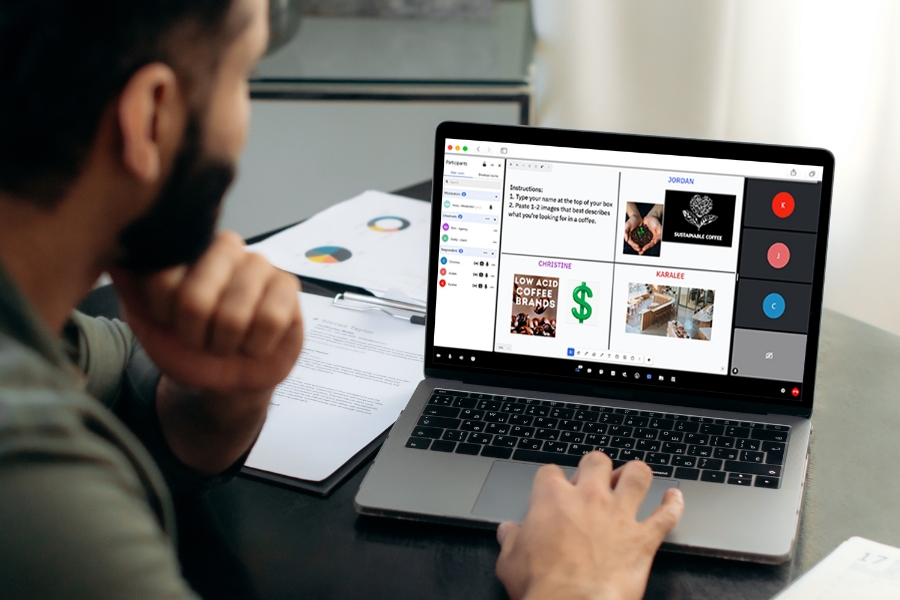
During fieldwork, CyberFacility functions as a central workspace, supporting private communication between moderators and observers, built-in polling or surveys, and dynamic presentation of materials. While recruitment is managed through coordinated systems such as CiviSelect® prior to the session, the transition into the live interview is made as uninterrupted as possible through active facilitation and early technical staging. This environment is maintained by dedicated technicians who are present for every session to address hardware and connectivity issues in real time. This human-led facilitation allows moderators to manage the interview without switching platforms, keeping the focus entirely on the respondent
Immediately After Sessions
The transition from a recording to actionable data is where most time is lost. Since recordings and session materials are already stored in a secure environment, researchers can proceed directly to review, transcription, or downstream analysis without exporting files across multiple systems. This continuity is often overlooked, but it has implications for both efficiency and data governance.
Integrating with Analysis and Reporting Workflows
One of the most common misconceptions is that integration ends at the end of the session. In practice, the real value of a research platform is determined by how tools for report writing and video capture are integrated into a virtual research project workflow.
CyberFacility works with Civicom’s broader research ecosystem, which includes report writing, data management, and AI-assisted analysis tools, such as Quillit. For researchers, this means they can move into analysis without manual restructuring or re-uploading. The benefit is not just speed, but also consistency in documentation and report writing: discussion guides, respondent inputs, and session context remain aligned as analysis progresses.
This alignment matters when teams revisit data weeks later or when multiple analysts are involved. A transparent chain from session to forming insights reduces interpretation errors and makes data validation easier.
Privacy, Compliance, and Workflow Design
Privacy controls are not just add-ons. They are foundational to the research design, influencing how studies are designed and how respondents engage. Features such as live video blurring, audio masking, and secure web rooms affect recruitment language, consent processes, and moderator capabilities. When these features are integrated into the workflow at the beginning of the research process, researchers can focus on study designs that encourage openness with lowered risk.
From an operational standpoint, keeping sensitive data within a private cloud environment simplifies compliance reviews. Instead of documenting multiple vendors and their transfer points, teams can point to a more contained, audited data flow. This is particularly important for healthcare, financial, and legal research, where “data in transit” represents a significant liability
Common Integration Challenges and How Teams Address Them
Even with a research-specific platform, integration is not automatic. Qualitative workflows span multiple phases and roles, and the benefits of a dedicated platform depend on when and how it is introduced. If CyberFacility is treated as a replacement for a conferencing tool rather than as part of the research infrastructure, teams are likely to carry over fragmented processes from earlier stages of the project. The most common challenges arise when platform decisions are made too late or without shared expectations.
Late-Stage Adoption: When CyberFacility is introduced only after recruitment or scheduling decisions are finalized, researchers may miss opportunities to simplify logistics or enhance the respondent experience. Teams that see the most benefit in integration tend to include platform considerations during kickoff, not during technical checks.
- Over-Customization: Teams sometimes attempt to replicate familiar workflows from other platforms rather than adapting their processes to fit research-focused tools. This can limit the usefulness of features such as observer controls or in-session polling.
- Stakeholder Alignment: Moderators, project managers, and clients should understand how sessions will run and what each role can access. Clear expectations reduce interruptions during live sessions and prevent post-session confusion
What Changes When CyberFacility Is Fully Integrated
When CyberFacility is treated as part of the research workflow rather than a stand-alone tool, several changes tend to occur:
- Fewer handoffs between systems during fieldwork and analysis
- More consistent handling of privacy and observer access across projects
- Cleaner transitions from live sessions to reporting
- Less reliance on improvised solutions during high-stakes sessions
These changes do not alter the fundamentals of research, but they do affect how smoothly projects run and how confidently teams can focus on interpretation rather than logistics.
Designing Qualitative Research for Continuity
Ultimately, integrating a dedicated virtual focus group platform into a qualitative research workflow is less about adding a new tool and more about reducing operational fragmentation. When platform considerations are addressed during study design, researchers can create a controlled environment in which privacy, observation, and analysis are built into the project lifecycle rather than treated as afterthoughts.
For experienced qualitative teams, the question is not whether a platform can host an interview. It is whether it supports the full arc of research work without introducing unnecessary complexity.
CyberFacility, powered by Civicom, is designed to function as that infrastructure. By centralizing live session tools and providing dedicated technical support throughout fieldwork, it allows moderators to stay focused on the conversation itself while maintaining a professional, uninterrupted research environment.
 Carl Roque • March 20, 2026
 Melody Rioveros • February 4, 2026