





Highlights
Quillit takes on the manual process of summarizing and segmenting datasets and surfacing patterns while keeping full transparency through citations and validation.
Researchers maintain ownership of data interpretation, narrative building, and final decision-making, supported (not replaced) by AI-generated structure.
Combining Quillit’s efficiency with human expertise creates a balanced workflow that manages large volumes of qualitative data while preserving accuracy, context, and research integrity.
Qualitative researchers have always navigated a demanding workflow: managing large volumes of transcripts, identifying themes across interviews, validating participant quotes, and shaping those findings into a structured, client-ready report. As datasets grow and timelines tighten, many research teams turn to AI tools for support. But the real opportunity isn’t choosing between AI and human expertise—it’s learning how to combine the two in a way that creates clarity, structure, and confidence in the research process and final output.
This balance is where qualitative research is headed: AI to handle the heavy lift of organization and synthesis, and the researcher to interpret meaning, apply context, and ensure the credibility of the final narrative.
AI report writing tools save time, but human proficiency brings depth. In this blog, find out how AI tools like Quillit can bridge both for effective qualitative data analysis and reporting.
The Growing Role of AI Tools in Report Writing
The global AI writing assistant software market continues to expand, with expectations of significant growth driven by the need for faster, structured data interpretation and large-scale content processing.
According to Market Research Future, the global market for AI writing assistant software is expected to increase from $1,478.73 billion by 2034 to $88.99 billion in 2025, with a compound annual growth rate (CAGR) of 36.65%. This rate hike is a result of AI’s growing ability to summarize, analyze, transcribe, and do other report-creation tasks.
For qualitative researchers, this trend signals not replacement—but reinforcement. AI tools help researchers with fragmented data sources, time-consuming manual tasks, and the pressure to meet shortened deadlines.
Why Balancing AI and Human Expertise Matters

The use of AI tools has become a central part of qualitative research workflows because it helps researchers handle tasks that require speed, organization, and the ability to process large amounts of data. However, human interpretation remains irreplaceable—especially for understanding nuance, evaluating context, and determining what matters most for the client.
Balancing the use of AI and human expertise in qualitative research workflows means enabling these AI tools to handle repetitive, time-consuming steps while researchers remain in control of the final interpretation and storytelling.
How Quillit Supports a Balanced Workflow
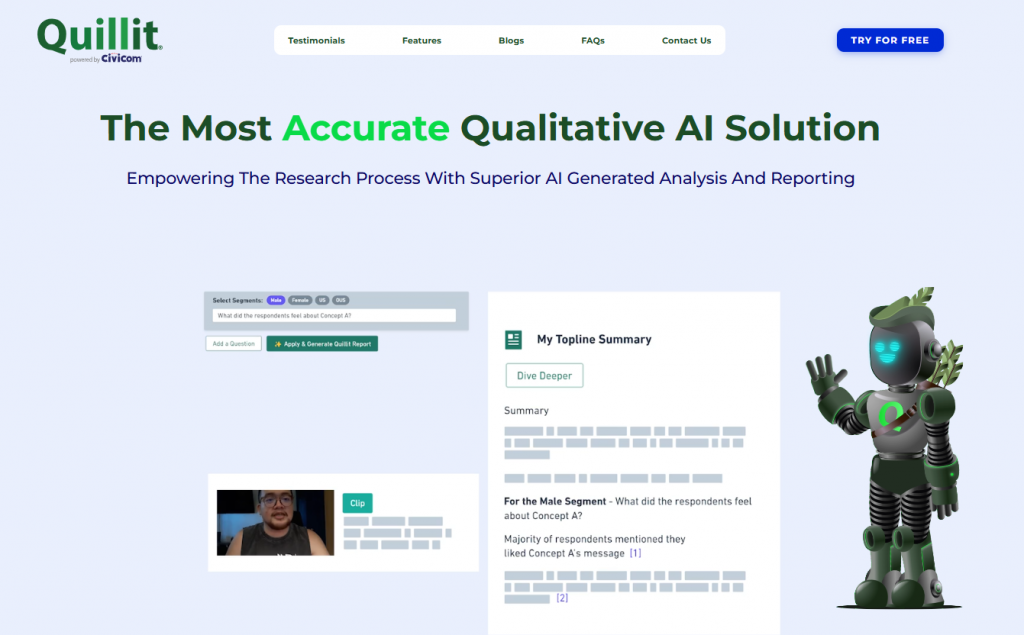
Quillit, powered by Civicom, can help you power through your workflow and transform the way qualitative data is managed, analyzed, and reported. It is designed to help researchers quickly and securely navigate large volumes of unstructured data, making qualitative analysis faster and more efficient.
With Quillit, you can enhance your existing research processes by improving the analysis, extraction, and synthesis of human-centered insights. While Quillit can accelerate time-consuming tasks, it complements the critical role of human expertise, preserving the depth and nuance of qualitative data.
Here’s how Quillit features support the balance between AI-driven efficiency and human interpretation:
1. Summaries for First-Draft Structure
With the Quillit Summaries feature, researchers can extract key highlights from datasets and produce first-draft report summaries based solely on the researcher’s supplied data. This entails spending less time organizing and more time on analyzing critical data.
2. Segmentation for Faster Data Navigation
Instead of tagging hundreds of responses or reorganizing content manually, researchers can sort data by themes, demographics, or attributes in minutes with the Quillit Segmentation feature. This feature can help researchers reduce manual processing time and allows them to enter an infinite number of segments that are tailored to their specific project requirements. Researchers can also compare demographic characteristics, such as age, location, or job title, that are used to categorize responses.
3. Validation and Citations That Reinforce Transparency
With Quillit multi-layer validation tools, researchers can generate direct, verbatim quotes to support their findings and link each insight to its original data source through its “Clickable Citations” feature. This feature links every insight to its original data source, whether an uploaded file, participant quotation, audio transcript, or observation note.
This level of traceability supports the growing need for transparent data methods in market research, academia, and other fields. It can help enhance report integrity, particularly in research work and client deliverables, where source attribution and methodological rigor are essential. It also makes the research analysis process more transparent and verifiable, which reduces interpretative bias.
4. AI Chat for Deeper Exploration
Quillit’s AI Chat feature helps researchers move beyond surface-level themes to uncover deeper insights, all while keeping data secure and enabling real-time interaction with the research material. It was created to derive deeper insights from text-based data, such as focus group conversations, interview transcripts, and open-ended survey responses.
Researchers can dive deeper into theme exploration and gain more accurate feedback with Quillit's AI Chat. This feature helps close the gap between text-based analysis and in-depth exploration of the research material, as if you are conversing with it.
5. Analysis Grid for Structured, High-Volume Review
Through Quillit Analysis Grid, researchers can aggregate verbatim quotes, key findings, and essential segments from various data sources, all within a structured grid layout. This powerful feature allows researchers to view all critical information in one place, eliminating the need to sift through lengthy transcripts manually.
Researchers can automatically organize and summarize qualitative data, providing a clear, structured view of the key insights. This innovative tool harnesses AI technology to segment data, search for relevant keywords, and generate actionable insights faster than traditional manual coding qualitative data methods, giving you more time to focus on strategic decision-making.
Where Quillit Supports You—and Where Human Expertise Leads
Here are some of the best practices to keep both AI and human expertise working together effectively:
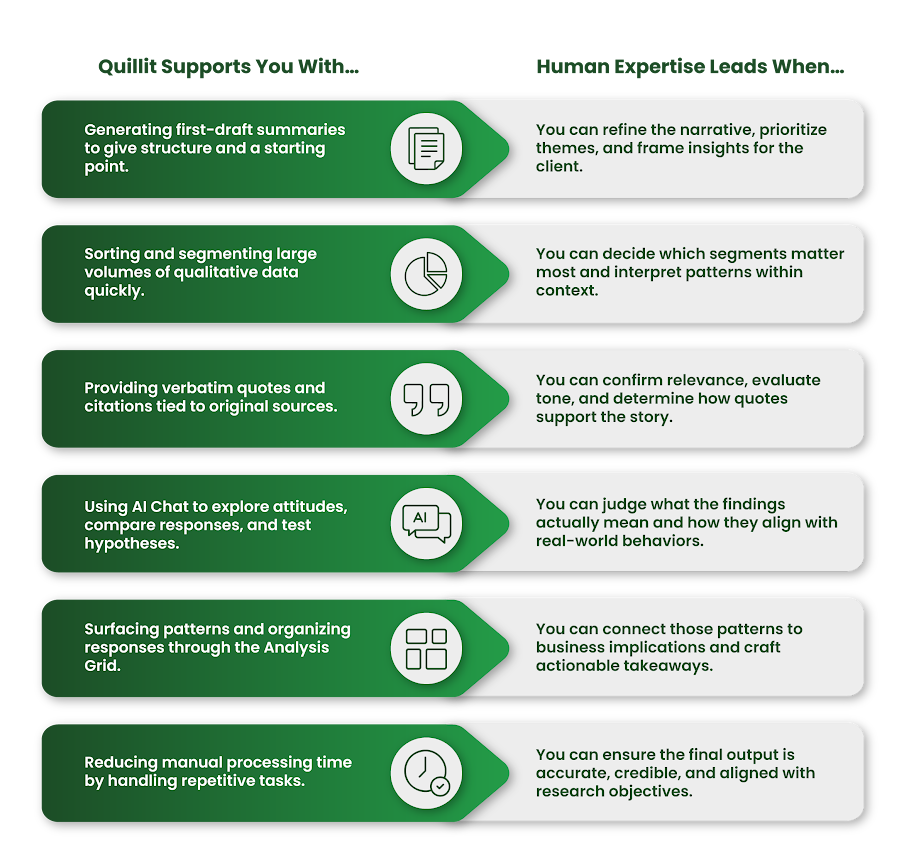
Key Points
Balancing the use of AI tools with human expertise strengthens research workflows, with AI managing organization and researchers ensuring accuracy and clarity. Quillit provides structure, speed, and reliable data access in a secure, qualitative-focused environment.
Market Research Report Writing Made Easy with Quillit®
Quillit is an AI tool developed by Civicom to streamline qualitative market research report development. It provides comprehensive summaries and answers to specific questions, verbatim quotes with citations, and tailored responses using segmentation.
Quillit is GDPR and HIPAA compliant. Your content is partitioned to protect data privacy. Contact us to learn more about Quillit.
 Melody Rioveros • October 29, 2025
 Louise Principe • February 7, 2023